|
| vtBuilding & | operator= (const vtBuilding &v) |
| |
| void | SetFootprint (int i, const DLine2 &dl) |
| |
| void | SetFootprint (int i, const DPolygon2 &poly) |
| |
|
const DPolygon2 & | GetFootprint (int i) const |
| |
|
const DLine2 & | GetOuterFootprint (int i) const |
| |
|
bool | GetBaseLevelCenter (DPoint2 &p) const |
| |
|
void | SetRectangle (const DPoint2 ¢er, float fWidth, float fDepth, float fRotation=0.0f) |
| |
| void | SetCircle (const DPoint2 ¢er, float fRad) |
| |
| void | FlipFootprintDirection () |
| |
| float | CalculateBaseElevation (vtHeightField *pHeightField) |
| |
| void | TransformCoords (OCTransform *trans) |
| |
| void | SetRoofType (RoofType rt, int iSlope=-1, int iLev=-1) |
| |
|
RoofType | GetRoofType () const |
| |
|
RGBi | GuessRoofColor () const |
| |
|
void | SetRoofColor (const RGBi &rgb) |
| |
| void | SetColor (BldColor which, const RGBi &color) |
| |
| RGBi | GetColor (BldColor which) const |
| |
| void | SetNumStories (int i) |
| |
| int | NumStories () const |
| |
|
float | GetTotalHeight () const |
| |
|
uint | NumLevels () const |
| |
|
vtLevel * | GetLevel (int i) |
| |
|
const vtLevel * | GetLevel (int i) const |
| |
|
vtLevel * | CreateLevel (const DPolygon2 &footprint) |
| |
|
vtLevel * | CreateLevel () |
| |
|
void | InsertLevel (int iLev, vtLevel *pLev) |
| |
|
void | DeleteLevel (int iLev) |
| |
|
bool | GetExtents (DRECT &rect) const |
| |
|
void | Offset (const DPoint2 &delta) |
| |
| double | GetDistanceToInterior (const DPoint2 &point) const |
| |
|
void | WriteXML (GZOutput &out, bool bDegrees) const |
| |
|
void | AddDefaultDetails () |
| |
|
void | DetermineLocalFootprints () |
| |
|
const FPolygon3 & | GetLocalFootprint (int i) const |
| |
|
bool | IsContainedBy (const DRECT &rect) const |
| |
|
void | SwapLevels (int lev1, int lev2) |
| |
|
void | SetEaves (float fLength) |
| |
|
void | SetEavesSimple (float fLength) |
| |
|
void | SetEavesFelkel (float fLength) |
| |
|
void | CopyStyleFrom (const vtBuilding *const pSource, bool bDoHeight) |
| |
|
void | SetCRS (vtCRS *proj) |
| |
|
void | CopyFrom (const vtStructure &v) |
| |
|
void | SetType (vtStructureType t) |
| |
|
vtStructureType | GetType () const |
| |
|
void | SetElevationOffset (float fOffset) |
| |
|
float | GetElevationOffset () const |
| |
|
void | SetAbsolute (bool b) |
| |
|
bool | GetAbsolute () const |
| |
|
vtBuilding * | GetBuilding () |
| |
|
vtFence * | GetFence () |
| |
|
vtStructInstance * | GetInstance () |
| |
|
void | WriteTags (GZOutput &out) const |
| |
|
void | AddTag (const vtTag &pTag) |
| |
|
void | AddTag (const char *name, const char *value) |
| |
|
vtTag * | FindTag (const char *szTagName) |
| |
|
const vtTag * | FindTag (const char *szTagName) const |
| |
|
vtTag * | GetTag (int index) |
| |
|
const vtTag * | GetTag (int index) const |
| |
|
uint | NumTags () const |
| |
|
void | RemoveTag (int index) |
| |
|
void | RemoveTag (const char *szTagName) |
| |
|
void | Clear () |
| |
|
void | SetValueString (const char *szTagName, const vtString &string, bool bCreating=false) |
| |
|
void | SetValueBool (const char *szTagName, bool value, bool bCreating=false) |
| |
|
void | SetValueInt (const char *szTagName, int value, bool bCreating=false) |
| |
|
void | SetValueFloat (const char *szTagName, float value, bool bCreating=false) |
| |
|
void | SetValueDouble (const char *szTagName, double value, bool bCreating=false) |
| |
|
void | SetValueRGBi (const char *szTagName, const RGBi &value, bool bCreating=false) |
| |
|
const char * | GetValueString (const char *szTagName, bool bSuppressWarning=false) const |
| |
|
bool | GetValueBool (const char *szTagName) const |
| |
|
int | GetValueInt (const char *szTagName) const |
| |
|
float | GetValueFloat (const char *szTagName) const |
| |
|
double | GetValueDouble (const char *szTagName) const |
| |
|
RGBi | GetValueRGBi (const char *szTagName) const |
| |
|
bool | GetValueString (const char *szTagName, vtString &string) const |
| |
|
bool | GetValueBool (const char *szTagName, bool &bValue) const |
| |
|
bool | GetValueInt (const char *szTagName, int &iValue) const |
| |
|
bool | GetValueFloat (const char *szTagName, float &fValue) const |
| |
|
bool | GetValueDouble (const char *szTagName, double &dValue) const |
| |
|
bool | GetValueRGBi (const char *szTagName, RGBi &color) const |
| |
|
vtTagArray & | operator= (const vtTagArray &v) |
| |
|
bool | operator== (const vtTagArray &v) const |
| |
|
bool | operator!= (const vtTagArray &v) const |
| |
|
void | CopyTagsFrom (const vtTagArray &v) |
| |
|
bool | WriteToXML (const char *fname, const char *title) const |
| |
|
void | WriteToXMLBody (FILE *fp, int iIndent) const |
| |
|
bool | LoadFromXML (const char *fname) |
| |
|
virtual bool | OverrideValue (const char *szTagName, const vtString &string) |
| |
|
virtual void | WriteOverridesToXML (FILE *fp) const |
| |
|
void | LogTags () const |
| |
This class contains a parametric representation of a building.
The geometry is described by a series of levels (vtLevel), each of which contains a set of edges (vtEdge), which in turn are composed of edge features (vtEdgeFeature). These components can vary in color, material, size, and number, which gives a high-level representation of a building, which can be used to construct a reasonable (visually similar) model of the building.
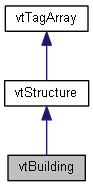
 Public Member Functions inherited from vtStructure
 1.8.10

