Water Rendering and Simulation
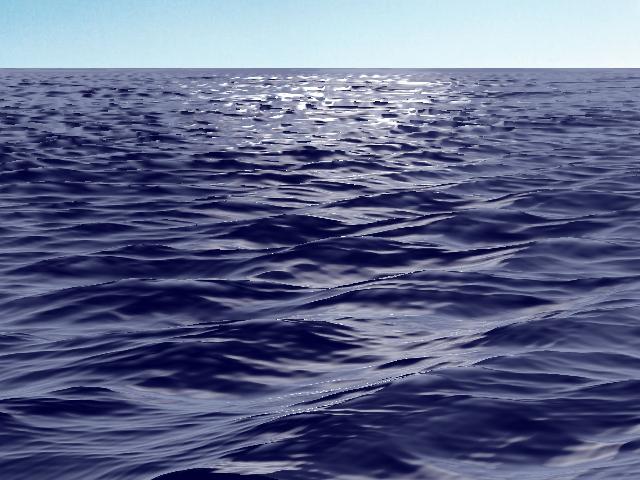
- The color of water is influenced by a very large number of
factors, especially by
sky color
and light conditions, so it's radically different on a sunny day vs. an
overcast day.
Realtime: Academic Work
-
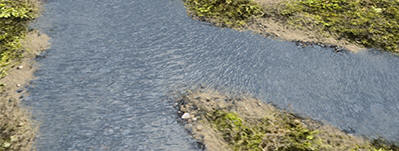
Scalable Real-Time Animation of Rivers, 2011
- Uses a pixel shader on overlapping tiles, with a 'flow' texture
providing the speed, direction and size of the waves so they can vary
over a scene.
- Provides a good expanation on the topic, pictures, movies and even
source code built on OSG 2.8.3
- Source code is on the page
Water shader
- Realtime
Interactive Animations of Liquid Surfaces with Lattice-Boltzmann Engines,
Cristian García Bauza et al., 2010
- The approach is intended to produce scenes of ponds whose surface
reacts to perturbations introduced by the user or controlled by the
computer, like drizzle or the stirring of a finger.
- the page
Phymo - Water Module has a public implementation with demos
- Scalable Real-Time
Animation of Rivers, Yu, Neyret, Bruneton and Holzschuch, 2009
- Treats the terrain and river as purely 2D, doing fluid flow
calculation of sparse particles, then renders those as "wave sprites".
- Looks nice, and very dynamic, although not particularly realistic.

- Implemented in the open-source terrain library
Proland.
- Real-time
Realistic Ocean Lighting using Seamless Transitions from Geometry to BRDF
- Bruneton Éric, Neyret Fabrice, Holzschuch Nicolas Comput. Graph.
Forum, 29 (2), 487-496, 2010
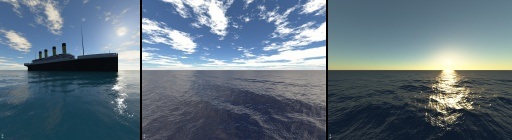
- Implemented in the open-source terrain library
Proland.
-
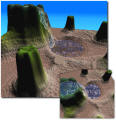 Realistic
and Interactive Simulation of Rivers, Peter Kipfer and Rüdiger
Westermann, 2006
Realistic
and Interactive Simulation of Rivers, Peter Kipfer and Rüdiger
Westermann, 2006
- From the abstract: Describes realtime physics-based simulation and
realistic rendering of rivers using Smoothed Particle Hydrodynamics.
Claims their method of generating the surface is far faster than the
Marching Cubes. approach, and is well suited for rendering.
- The demo video shows very tiny shallow streams of water, which look
rather unstable and artificial. The larger area demos (for a valley and
flooding) also looks unstable and less realistic than a simple water
heightfield.
-
GPU water simulation, Peter Trier and Karsten Noe,
2005
- open-source implementation of the 2D Kass et al. shallow water
simulation, with downloadable demo and accompanying
academic paper
- 'In the simulation we use Jacobi iteration for solving linear
systems. For the visualization we use a method based on the refraction
and reflection of light on the water surface.'
- requires an Nvidia Geforce 6200 or newer (it didn't run on my ATI
Radeon 9800)
-
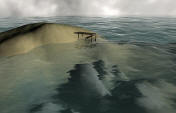 Real-time
water rendering - projected grid concept, 2004
Real-time
water rendering - projected grid concept, 2004
- thesis project of Claes Johanson, Sweden, building on previous
'projected grid' work
- includes binaries and DX9 source for a method of using the GPU to
create an animated water surface, using "a grid mesh whose vertices are
even-spaced, not in world-space, but in post-perspective camera space."
- result is very smooth, with great reflection/refraction appearance
-
Real-Time Fluid Dynamics for Games, Jos Stam, GDC 2003
- Jos extends his amazing Siggraph work into fast, stable and simple
implementation of 2D fluids
- C example code is included, both in the paper and linked from his
publications page
- numerous extensions of the code are described, including 3D fluids
and more realistic solutions
-
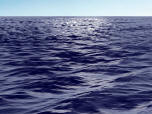
Interactive
Animation of Ocean Waves, 2002
- Damien Hinsinger,
Fabrice
Neyret, Marie-Paule Cani published the concept of a projected grid
for realtime water, which restricts computations to the visible part of
the ocean surface, adapts the geometric resolution to the viewing
distance and only considers the visible waves wavelengths.
Realtime Engines / Projects
- There is water in the open-source terrain library
Proland (see above)
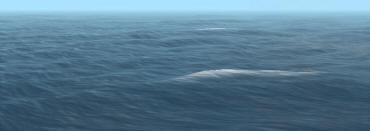
- osgOcean
- An add-on for the open-source OSG library which does deep-water wave
surfaces: Foam caps, Refraction/Reflection, God Rays, Surface glare,
Underwater depth of field, Simulated light absorption and scattering,
etc.
- CHENGINE
- implementation by Gottfried Chen of several of the known realtime
algorithms
- made the
flipCode Image of the Day 3/3/2002
- "source code for the water algos can be downloaded and used for
free"
-
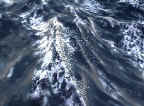 Deep-Water
Animation and Rendering
Deep-Water
Animation and Rendering
- Gamasutra article on realtime water, Sept. 2001
- rather heavy on math (perhaps unavoidably so)
- has example images, but no animations or source code
- good reference section, especially:
-
Water-Fire-Sky at
Bonzai Software
- demonstrates the realistic rendering of clean and foggy water, Fire
and Sky (OpenGL)
- A tutorial about the water effect is included
- uses
GL_ARB_vertex_program and
GL_ARB_fragment_program
-
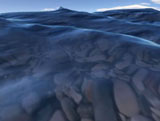 Joe
Dart's RoamAlaska water demo
Joe
Dart's RoamAlaska water demo
- an open-source implementation which follows the Tessendorf paper for
the basic approach, uses a take-off on Gottfried Chen's algorithm, and
Paul Bourke's FFT function
- downloadable from here: source
(33k),
binaries
(481k), and
data (3 MB)
- demo uses OpenGL, GLUT, and glew; compiles on Windows but is mostly
portable
- NVIDIA's Cg is used for the bottom refraction; it appears to work on
both contemporary GeForce and Radeon cards
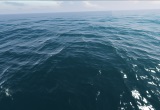 Typhoon is a realtime
terrain engine with an emphasis on sophisticated water rendering
Typhoon is a realtime
terrain engine with an emphasis on sophisticated water rendering
- waves, reflections, caustics, diffraction, floating particles
- written with C++ and DirectX, needs shader model 3.0
- as of June 2013, it's an R&D engine, but could become an SDK with
free/commercial licenses if there is interest
-
OpenGL-rendering
of Underwater Caustics
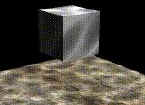
- tutorial by Mark Kilgard (of SGI/NVidia)
- includes source code and sample caustic textures
Commercial Realtime
-
Triton is an ocean-rendering library from Sundog Software, well-known for their cloud-rendering library SilverLining
Old/Historical
- Jeff Lander
- Agua demo
in Game Developer, Dec. 1999
-
Research on the Rhine: Reflections on Water Simulation in Game
Developer, Jan. 2000
- his FluidSim
page has lots of good academic references, including:
- Kass, Michael, and Gavin Miller, "Rapid,
Stable Fluid Dynamics for Computer Graphics," SIGGRAPH, 1990,
pp. 49-55
- Jeff says "This methods simplifies the full navier-stokes fluid
flow equations for shallow water. It uses a height map to represent
the water surface. I have implemented both the 2D and 3D versions of
this system and it is very suitable for realtime performance on the
scale I need."
- the realtime fish in
Artificial
Animals for Computer Animation (XiaoYuan Tu, Demetri Terzopolous,
Siggraph '96) involve some minimal realtime water contact forces
- 2D
Water page from Hugo Elias
- AnfyFluid 2.0
-
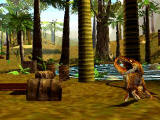 a
Java app with fake-ish "realtime water simulation"
a
Java app with fake-ish "realtime water simulation"
-
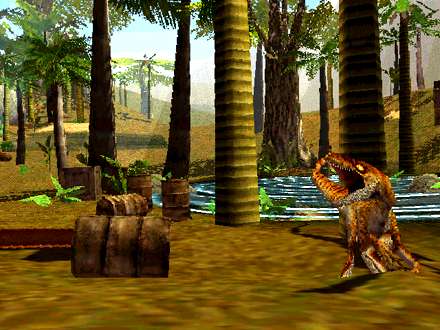
Trespasser
claimed wave dynamics and "diffraction-based rendering" in realtime
- the water surface does look nice, but the water itself is far too
transparent, a problem seen with other games as well
Non-realtime
- paper: Rendering
Natural Waters, Simon Premoze, Michael Ashikhmin, 2000
- there are companies like
Scientific Software Group that do non-realtime groundwater and
surface-water simulation which they claim are highly accurate
- RiverTools
- A software toolkit for digital terrain and river network analysis.
Was a free, academic tool, developed by Scott Peckham at University
of Colorado, then a commercial product from RSI, then spun off as its
own company Rivix LLC. As of 2008, it is $500/$900 a license.
- Includes extensive DEM tools, including formats and patching
together multiple DEM files.
- hydrologic operations including extracting drainage network patterns
- runs on Windows, Solaris, and Mac OS X
-
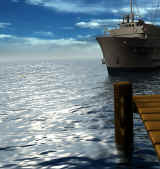 3D
modeler plugins
3D
modeler plugins
-
Seascape for MAX does nice surfaces for large bodies of water
- Splash! MAX
is a plugin that "makes water fluid dynamics easy"
- RealFlow, "the most
sophisticated fluid simulator on the market", uses a particle-based
approach which looks fairly good, but is naturally very non-realtime
- Jerry Tessendorf's tools and APIs for water simulation
and rendering, SeaMonster, WaveTools - no longer online?
- Open source computational packages:
OpenFOAM,
OpenFlower,
Gerris Flow Solver
- simulation should ultimately be considered when modeling any ecosystem
- Keith
Loague
of the Stanford Hydrogeology
Program
is an expert in the field who has done
work in Hawai‘i
- OpenEarth
- From Dutch universities, an initiative to deal
with data, models and tools in marine & coastal science & engineering
projects, starting with the 2008 release of open source OpenEarthTools
(OET)
- It is mostly concerned with simulating how water and sediment move;
keeping track of data (typically in NetCDF format), then visualization
is mostly by output to formats viewable in Google Earth.
- IST Visual Systems Lab (VSL)
claimed to have implemented a physically based, realtime hydrology model in
1993
- Campbell, Charles. "Fluid Dynamics Methodologies for Computer
Graphics", M.S. Thesis, University of Central Florida, Orlando, Florida,
1991.
- Jim Chen. "Physically-Based
Modeling and Real-Time Simulation of Fluids", Ph.D. Dissertation,
University of Central Florida, Orlando, Florida, May 1995.
- CatchmentSIM
- Was once a "freely available 3D-GIS topographic parameterization and
hydrologic analysis model. The model automatically delineates watershed
and subcatchment boundaries, generalizes geophysical parameters and
provides in-depth analysis tools to examine and compare the hydrologic
properties of subcatchments."
- At some point, it went commercial (Australian company, package costs
US$2000)
- Could be useful for operating on DEMs, e.g. using simulated
water erosion to provide detail and accuracy beyond USGS's 30m/10m grid
data
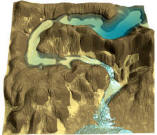
-
the
papers of
Bedřich Beneš
-
Interactive Terrain Modeling Using Hydraulic Erosion
(zipped pdf)
- Stava, O., Benes, B., Brisbin, M., and
Krivanek, O., Siggraph/Eurographics Symposium on Computer Animation
2008
- Interactive, because the three erosion algorithms (force-based
and dissolution-based hydraulic erosion, and direct material
transportation through sediment slippage) are GPU-based and run at
least 20 fps for scenes with grid resolution of 2048×1024.
-
Hydraulic Erosion
- Benes, B., Tesinsky, V., Hornys, J, Bhatia, S. K.,
Computer Animation and Virtual Worlds, 16, pp 1-10, 2006
-
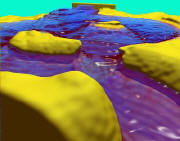 Visual Simulation of Hydraulic Erosion, 2002
- describes a simplified model of hydraulic erosion with a
heightfield grid
- Load Balancing in Parallel Implementation of Hydraulic Erosion
Visual Simulations, 2002
- shows how the task of simulating erosion can be distributed
among several computers (or CPUs) with message-passing between for
the state of their boundaries
- see Artificial Terrain
Generation
for more on this subject
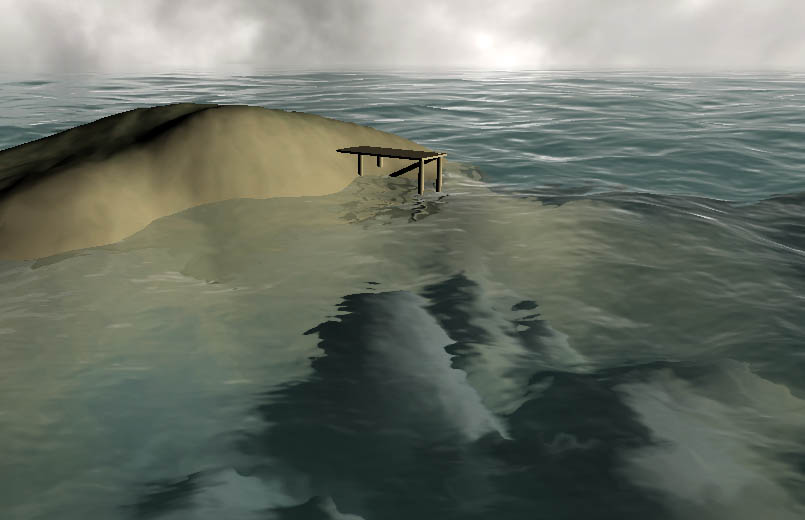 Real-time
water rendering - projected grid concept, 2004
Real-time
water rendering - projected grid concept, 2004